How long does it take to build an app?
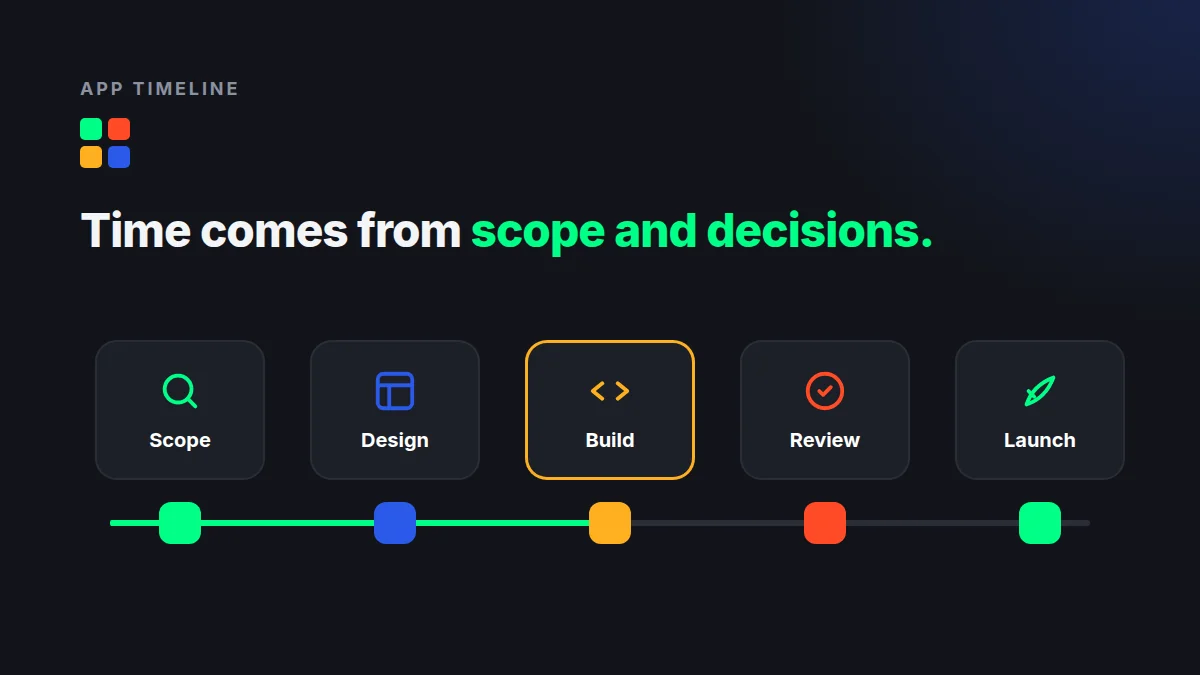
In short: It depends mostly on scope and on how quickly decisions get made. As one data point, Clutch's pricing data puts the usual timeline for software projects reviewed on its site at about 13 months, but a small first version can be far shorter. Plan the time in phases: scoping, design, build, testing, store review and launch. Store review alone can take from hours to about a week.
The phases of an app build
Every app goes through the same broad phases, even when they overlap:
- Scoping. Agree who the app is for, what the first version does and what waits. This is sometimes called discovery.
- Design. Sketch the screens and how they connect, then make them look right.
- Build. Write the app and its backend, in small pieces you can see working.
- Testing. Check it on real devices and with real people, and fix what they find.
- Store review. If the app goes in the Apple or Google store, wait for approval.
- Launch. Release it, watch it closely, and ship the first fixes.
The phases are not equal, and they are not strictly in order. Design and build usually overlap, with the first screens being built while later ones are still being drawn. Testing should run through the whole build, not wait for the end. The one phase that cannot be squeezed is store review, because it runs on Apple's and Google's schedule.
What the data says about each phase
Scoping has no fixed length. The UK government's service manual, writing about its own projects, says there is no set time period for a discovery, but around 4 to 8 weeks is typical. A small business app usually needs less, because there are fewer people to talk to.
Store review is the part you control least. Apple says App Review typically reviews at least 50% of submissions in less than 24 hours and 90% in less than 48 hours. Google's Play Console help says processing can take a few hours or up to seven days, or longer in exceptional cases, and suggests allowing at least a week between submitting and your launch date.
What slows an app down
- Waiting on decisions. The most common delay is not code. It is a question that sits unanswered for a week.
- Scope that grows. Each new feature added mid-build pushes everything behind it.
- Accounts nobody set up. Store accounts, payment provider approval and domain access take time. Apple, for example, requires organizations to have a D-U-N-S Number to enroll. Start these on day one.
- Content that arrives late. Text, prices, photos and legal pages often hold up a launch more than features do.
- Integrations with other companies. Getting access to someone else's system runs on their schedule, not yours.
What speeds it up
- A small first version. Fewer screens means less to design, build and test.
- One person who decides. Name one owner on your side who can say yes or no the same day.
- Seeing work every week. Short cycles catch misunderstandings while they are cheap to fix.
- Web first. A web app can be tested by anyone with a link and changed the same day, without waiting for store review.
- A launch checklist. Most last-minute delays are known in advance. See our app launch checklist.
How to get a timeline you can trust
Ask for the timeline in phases, with what you will see at the end of each one. A single date for the whole project hides where the risk is. Ask what the developer needs from you, and by when. Then ask what would make the date slip. A good answer names real risks, such as an integration or a store rule, not just "unexpected issues."
Be wary of a firm date given before anyone has asked you questions. A date without a scope is a guess.
Launch is not the finish line
Plan time after launch too. The first weeks bring bug reports, questions and requests you did not expect. If the team stops on launch day, nobody is left to act on them. We wrote about the running side in the real cost to keep an app running after launch.
How we approach it
We start with questions and a plan, agree the first version in plain English, and show you the screens before building them. We build the web app first, so you can use real screens early rather than wait for the end. More in how we build an app, from idea to launch.
Questions and answers
How long does Apple take to review an app?
Apple says App Review typically reviews at least 50% of submissions in less than 24 hours and 90% in less than 48 hours. Incomplete submissions take longer.
How long does Google Play review take?
Google's Play Console help says from a few hours up to seven days, or longer in exceptional cases. It suggests allowing at least a week before your launch date.
What is the biggest cause of app delays?
In most projects it is waiting: on decisions, content, accounts or another company's system. Naming one decision maker and setting up store and payment accounts early removes much of it.
Talk it through with us
A clear first version is the fastest route to a launch date you can believe. If you would like a second pair of eyes, ask for a free app idea review. If you are ready to talk about building it, tell us about it on our contact page. A few honest sentences is enough to start.