What is a discovery phase in app development?
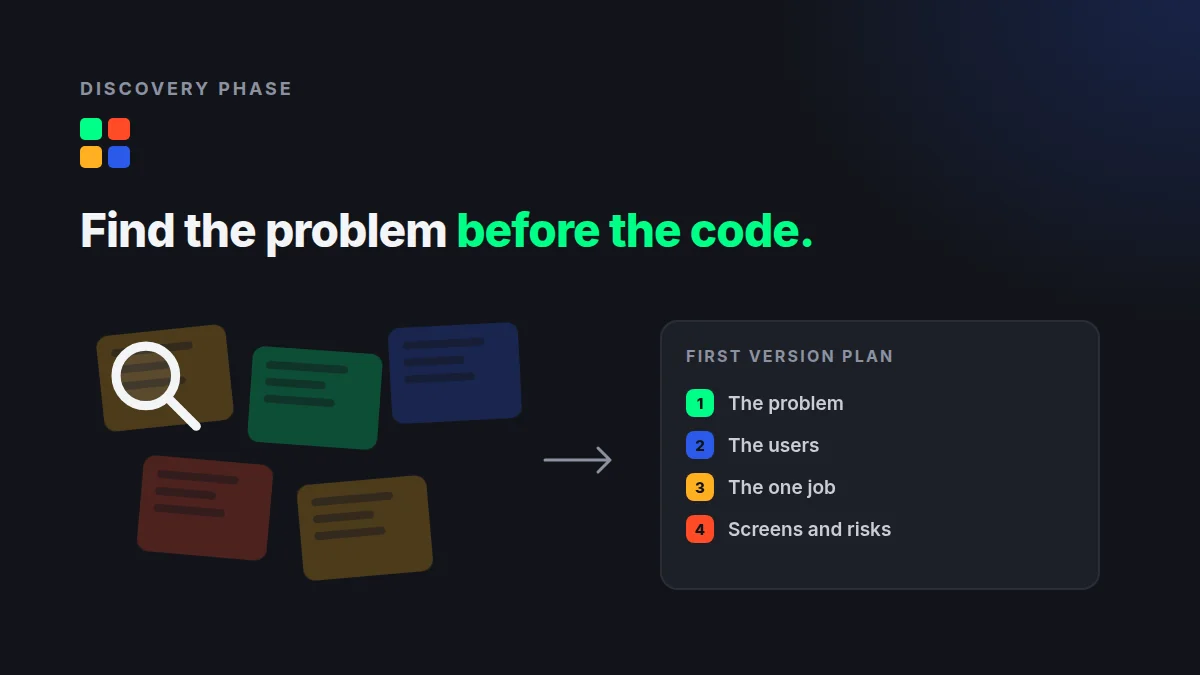
In short: A discovery phase, sometimes called scoping, is the short stretch before building where you and the developer settle who the app is for, what problem it solves, what the first version includes, and roughly what it will cost. No production code is written. It saves money because changing a plan costs far less than changing a finished app.
What discovery is for
The UK government's service manual puts it simply: "Before you commit to building a service, you need to understand the problem that needs to be solved." It also says you should not start building during discovery. That guidance was written for public services, but the logic holds for any app.
Most expensive mistakes in app projects are not coding mistakes. They are building the wrong thing, or the right thing for the wrong people. When CB Insights looked at 431 VC-backed companies that shut down since 2023, poor product-market fit was a cause for 43% of them. Discovery is where you test that risk on paper first.
What happens during discovery
- The problem. Who has it, what they do about it today, and what that costs them.
- The users. Short conversations with a few of the people who would use the app. Even five talks can change a plan.
- The first version. The one job the app must do well, and the list of things that wait.
- The screens. Rough sketches of the main screens and how they connect.
- The risks. Integrations, store rules, data rules and anything that could block the launch.
- The estimate. A cost and timeline for the first version, based on the agreed scope.
What you should have at the end
- A one-page description of the problem and the people the app serves.
- A written scope for the first version, in plain English, with an "after launch" list.
- Sketches of the main screens.
- A list of risks and how each will be handled.
- An estimate for the build that you can compare with others.
Those documents are yours. Even if you choose a different team to build the app, they make every later quote more accurate.
Why it saves money
Changing a sketch takes minutes. Changing a finished screen takes days, because the design, the code, the tests and often the data all change with it. Discovery moves the big decisions to the point where they are cheapest to make.
It also makes quotes honest. A developer who has been through discovery with you is pricing a defined scope, not a guess. Fewer surprises later means fewer change requests and fewer arguments about what was included.
Signs a project skipped discovery
- The build started from a feature list, with no one able to say which feature matters most.
- Nobody outside the project has seen the screens.
- Store accounts, payment approval and data rules come up for the first time near launch.
- The estimate keeps changing because the scope keeps changing.
How long it takes
It depends on the size of the problem. The UK service manual says there is no set time period for a discovery, but around 4 to 8 weeks is typical for its own services. A small business app with one kind of user usually needs much less. What matters is that the main questions get answered, not the number of weeks.
It is fine to stop
Sometimes discovery shows that the app should not be built yet, or should be built very differently. The UK manual says, "It's not a failure to stop at the end of the discovery phase if your research shows that's the best thing to do." Finding that out for the cost of a few weeks is a good result.
How to prepare
- Write down who the app is for and what they do today instead. Our guide on how to describe your app idea so it can be built has the five questions to answer.
- List the names of a few people who would use it and might talk to you.
- Collect anything you already have: spreadsheets, forms, screenshots of tools you use now.
- Decide who on your side will make decisions.
How we do it
For us, discovery starts with your message. We read it ourselves and reply with questions and a plan. We agree the first version in plain English and show you the screens and how they connect before any code is written. More in how we build an app, from idea to launch.
Questions and answers
What is a discovery phase?
The short stretch before building an app where you settle who it is for, what the first version does, what the main screens look like, the risks, and a cost estimate. No production code is written.
How long does a discovery phase take?
It depends on the problem. The UK government's service manual says around 4 to 8 weeks is typical for its services. A small business app with one kind of user usually needs less.
Is a discovery phase worth paying for?
Usually, because it moves the big decisions to when they are cheapest to change and makes the build quote accurate. Make sure you keep the written scope and sketches it produces.
Talk it through with us
Discovery turns a rough idea into something you can price and build. If you would like a second pair of eyes, ask for a free app idea review. If you are ready to talk about building it, tell us about it on our contact page. A few honest sentences is enough to start.