MVP vs full app: what to build first
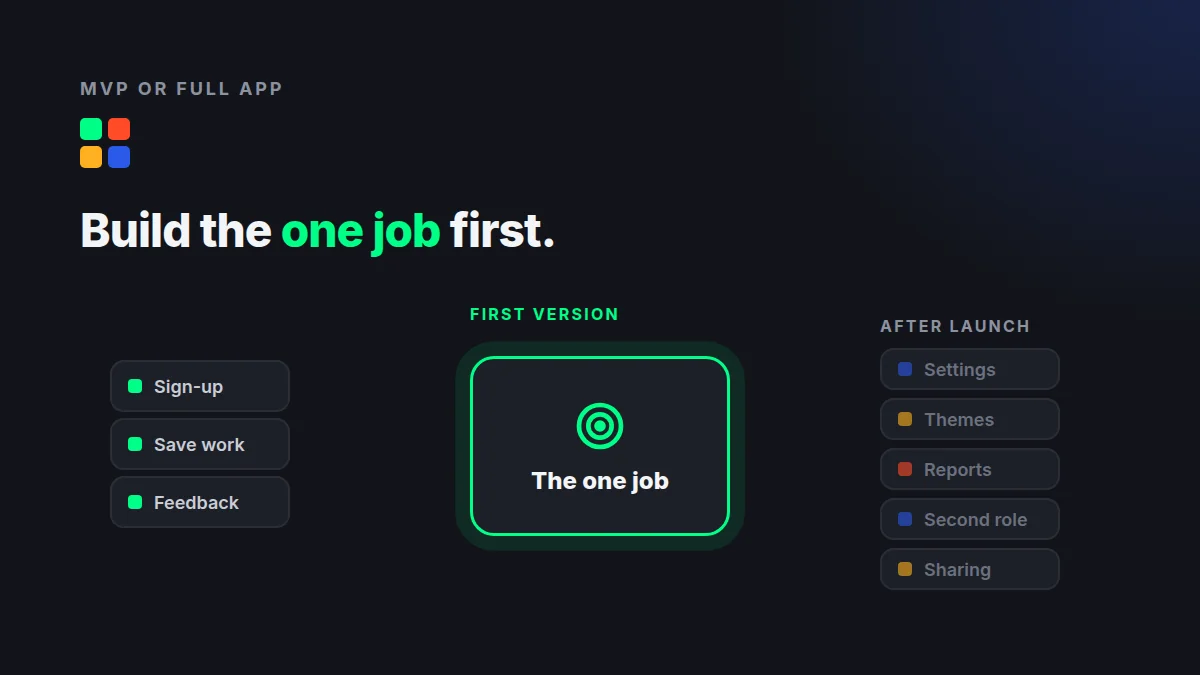
In short: Build the smallest version that does the main job well, put it in front of real people, and let what they do decide the next step. That is a minimum viable product, or MVP. A full app first only makes sense when the requirements are already known and fixed, for example when you are replacing a tool your team already uses every day.
What an MVP is, and what it is not
The term comes from the Lean Startup method. Its principles page describes building an MVP "to begin the process of learning as quickly as possible," then measuring how customers respond and deciding whether to pivot or persevere.
An MVP is not a broken or ugly app. It is a narrow one. It does one job, and it does that job well enough that people come back. Everything around that job can be plain.
An MVP is also not a prototype. A prototype is something you show. An MVP is something people use, with real accounts and real data.
Why the first version should be small
The biggest risk for a new app is not a bug. It is building something people do not want. When CB Insights studied 431 VC-backed companies that shut down since 2023, poor product-market fit was a cause for 43% of them. A small first version tests that risk for the least money.
A smaller build also launches sooner. Every week the app is live, you learn something a planning meeting could not tell you: which screen people skip, where they get stuck, what they ask for that you never thought of.
It also keeps your budget in reserve. Money not spent on features nobody uses is money you can spend on the features people do ask for once the app is live. A full build spends that money up front, before anyone has told you what they need.
How to choose what goes in
Start with the one job. Write it as a sentence: "A parent can see this week's homework and mark it done." Then ask of every other feature: does the app fail at that job without it?
- In: sign-up, the core job, and whatever makes the core job trustworthy, such as saving work or sending a confirmation.
- In: a simple way for users to tell you something is wrong.
- In: basic analytics, so you can see whether people finish the core job.
- Later: settings pages, themes, social sharing, a second user type, detailed reports.
- Later: a second platform, if one platform can prove the idea.
If you are not sure what the one job is, start with how to describe your app idea so it can be built. It walks through the five questions we ask first.
When a full app first does make sense
Sometimes the MVP approach is the wrong fit. A bigger first build can be the right call when:
- You are replacing a system people already depend on, and a half version would stop their work.
- The requirements are fixed by a contract, a regulation or a partner, so there is little to learn by launching early.
- The market already has strong apps, and a narrow version would not be worth switching for.
Even then, it helps to release in stages to a small group first. Real use finds problems that testing does not.
How to tell if the MVP worked
Decide before launch what success looks like, and write it down. Good first measures are simple:
- How many people who sign up finish the core job once.
- How many come back and do it again within a week.
- What the first twenty people who contact you ask for.
If people finish the job and come back, build the next most requested piece. If they sign up and leave, talk to them before you build anything else. The answer is usually in those conversations.
The trap: a small app with a big backlog
A first version stays small only if someone protects it. Each "quick addition" during the build delays the launch and the learning that comes with it. Keep a list called "after launch" and move ideas there. Most of them will look different once real users have spoken.
How we approach it
We write the first version down in plain English before any code, so you can check it without reading code. For our own apps, that meant one job each: ProfVault started with filling in a job application from documents you have already stored, and everything else waited. More in how we build an app, from idea to launch.
Questions and answers
What does MVP stand for?
Minimum viable product: the smallest version of an app that real people can use for its main job, built to learn whether they want it before you build more.
Is an MVP the same as a prototype?
No. A prototype is shown to people, often as clickable screens. An MVP is used by people, with real accounts and real data.
How do I decide what goes into my MVP?
Write the app's one job as a sentence. Keep a feature only if the app fails at that job without it. Move everything else to an after-launch list.
Talk it through with us
Choosing the first version is the most valuable decision in the whole project. If you would like a second pair of eyes, ask for a free app idea review. If you are ready to talk about building it, tell us about it on our contact page. A few honest sentences is enough to start.