How to protect your app idea: NDAs, IP and ownership
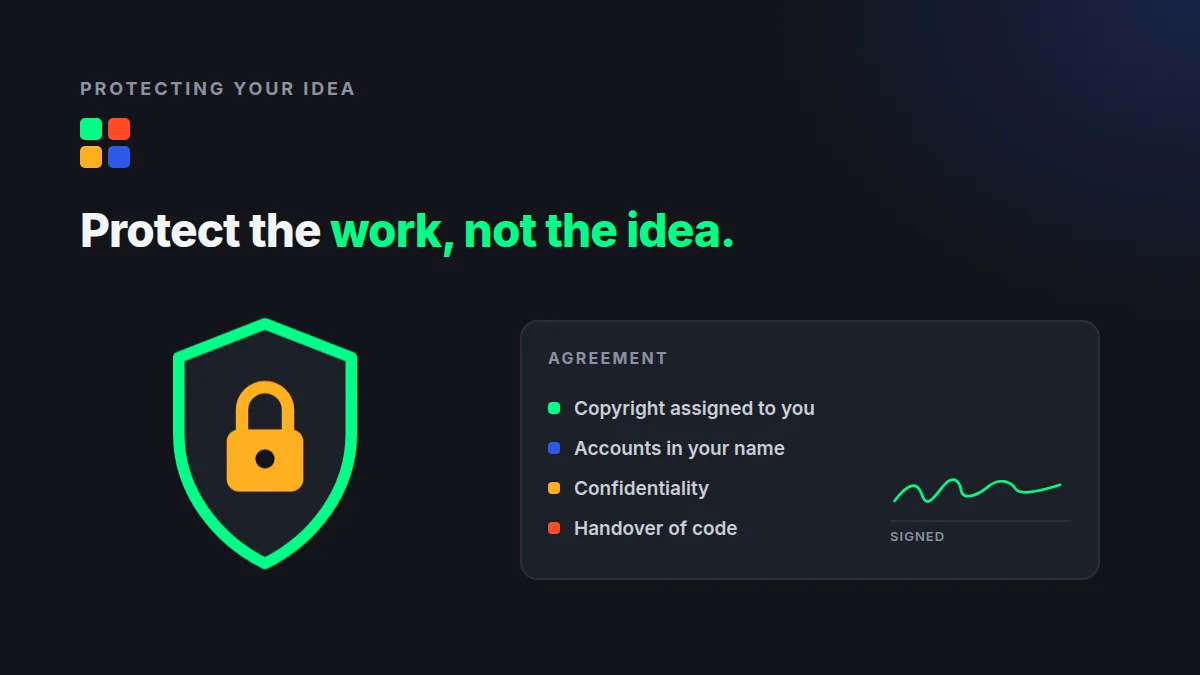
In short: The law protects what you make, not the idea itself. Copyright covers the code and design once they exist, and a patent needs an actual invention, not a suggestion. What protects most founders in practice is a written contract that assigns the work to them, accounts held in their own name, and care about what they share. This is general information, not legal advice. For your situation, talk to a lawyer.
Why an idea on its own is hard to protect
The US Copyright Office says plainly that copyright does not protect facts, ideas, systems, or methods of operation. It may protect the way those things are expressed: your written description, your designs, your code.
Patents are no different on this point. The USPTO says abstract ideas cannot be patented, "nor can only an idea or suggestion." An invention has to be new, useful, not obvious and clearly described.
This is less worrying than it sounds. Ideas are common. What is rare is the work of turning one into an app people use, and that work is what the law and your contracts can protect.
Copyright: the code and design
Copyright covers original expression, which includes code, screen designs, text and images. The question for a founder is who owns that copyright when someone else writes the code.
The Copyright Office's circular on works made for hire explains that a work commissioned from an outside party counts as "made for hire" only if it fits one of nine listed categories and both sides sign a written agreement saying so. App code is not on that list. So for an app built by a contractor or agency, ask for a written assignment of copyright to you in the contract, and have a lawyer check the wording.
Trade secrets: what you keep private
Some parts of an app are worth more when nobody else knows them: a pricing model, a matching method, a data set. The USPTO describes a trade secret as information with value because it is not generally known, where the owner makes reasonable efforts to keep it secret. If those efforts stop, the protection can end. In practice, that means sharing sensitive details only with people who need them, and only under a confidentiality agreement.
NDAs: useful, but not magic
A non-disclosure agreement is a contract in which someone promises to keep what you tell them confidential. It is a reasonable thing to ask for before you share sensitive details. Keep its limits in mind:
- It protects what you share, not the idea in general. Someone who thinks of the same idea on their own is not bound by it.
- It only helps if you can show what you shared and when. Keep written records.
- You do not need one for a first conversation. "A booking app for dog groomers" is not a secret. Your customer list and your pricing method might be.
A practical approach: describe the problem and the people the app is for in a first conversation. Share the sensitive parts once you have chosen who to work with and have an agreement in place.
Ownership checklist for a contracted app
- Copyright assignment. A clause that assigns the code, designs and content to you on payment.
- Accounts in your name. The Apple and Google developer accounts, the domain, the hosting and the code repository. Give the developer access, not ownership.
- Third-party code. Apps use open source libraries and paid services. Ask for a list, so you know what is licensed rather than owned.
- Confidentiality. A clause covering what each side learns about the other's business.
- Handover. What you receive at the end: code, credentials, documentation.
Names and logos
Your app's name and logo can matter as much as its code. Check that the name is not already in use for a similar product before you build a brand on it. A lawyer can tell you whether registering a trademark is worth it for your case.
The best protection is speed and execution
The protection most founders overlook is simply getting to market well. A live app with real users, a clear website and steady updates is hard to copy, because the hard part was never the idea. More on that in how we build an app, from idea to launch.
How we handle it
We read every idea ourselves and reply by email. If you want an NDA before sharing the sensitive parts, say so when you get in touch. We also set apps up to go live on your own domain. For the details that matter to your business, have your lawyer review the contract.
Questions and answers
Can I copyright or patent an app idea?
Not the idea alone. The US Copyright Office says copyright does not protect ideas, only their expression, and the USPTO says an idea or suggestion alone cannot be patented. This is general information, not legal advice.
Should I ask an app developer to sign an NDA?
It is reasonable before you share sensitive details such as customer data, pricing methods or unreleased plans. For a first conversation about the problem you are solving, it is usually not needed.
How do I make sure I own my app's code?
Put a written assignment of copyright to you in the contract, keep the developer accounts, domain, hosting and code repository in your own name, and ask a lawyer to review the agreement.
Talk it through with us
You can start with the problem, not the secret. If you would like a second pair of eyes, ask for a free app idea review. If you are ready to talk about building it, tell us about it on our contact page. A few honest sentences is enough to start.